
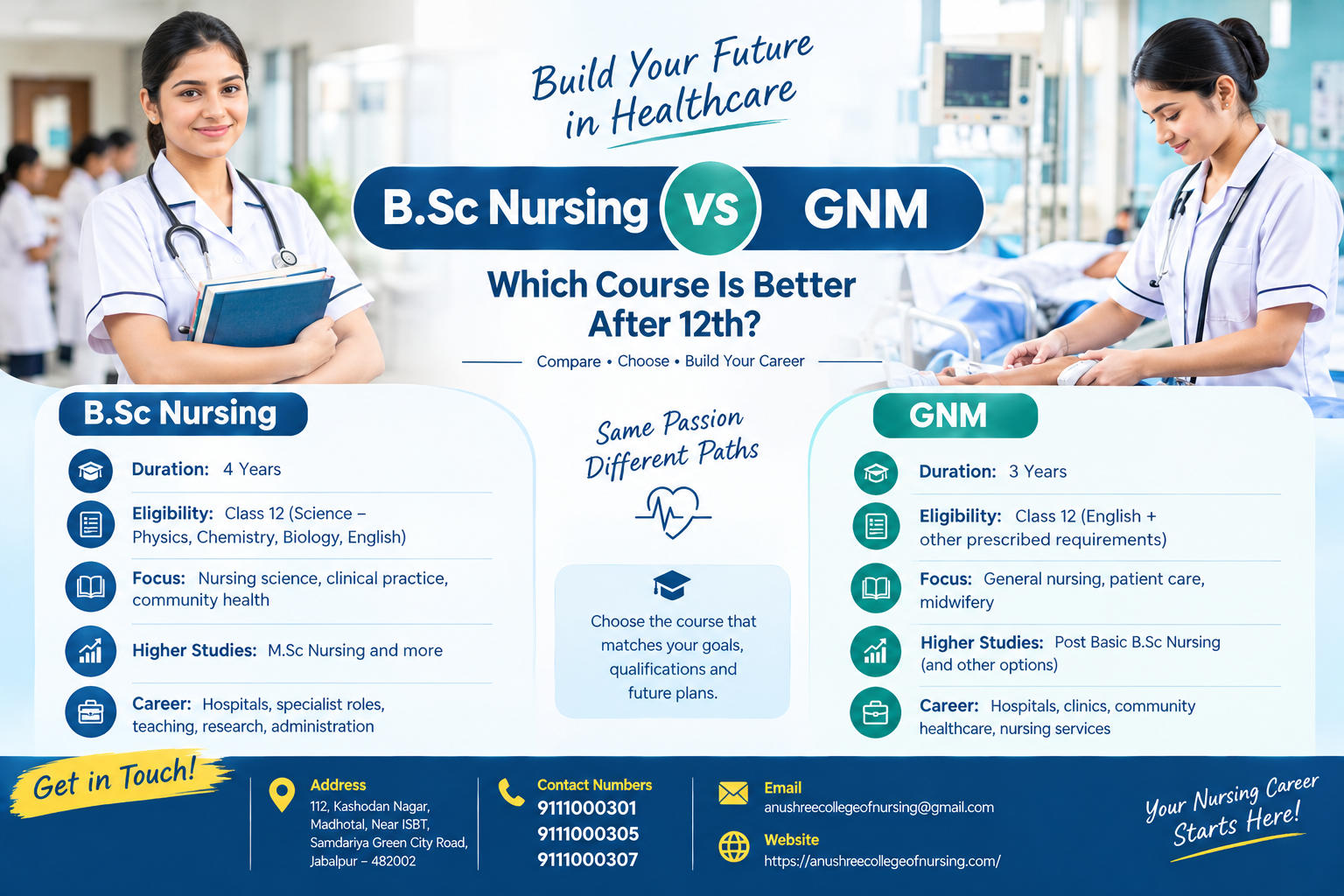
B.Sc Nursing vs GNM in 2026: Which Course Is Better After 12th?
Choosing the right nursing course after Class 12 is an important decision for students who want to build a career in healthcare. Two popular options are Bachelor of Science in Nursing (B.Sc Nursing) and General Nursing and Midwifery (GNM). Both programmes focus on nursing knowledge, patient care, and clinical skills, but they differ in qualification level, duration, eligibility, and opportunities for further education.
If you are searching for B.Sc Nursing vs GNM in 2026, this detailed guide will help you understand the differences and decide which course may suit your academic background and career goals. Students looking for a Nursing Institution in Jabalpur can also use this guide to understand what to check before selecting a college.
What Is B.Sc Nursing?
B.Sc Nursing, or Bachelor of Science in Nursing, is an undergraduate professional degree programme designed to prepare students for nursing practice and broader responsibilities in healthcare. It combines theoretical education with laboratory learning, supervised clinical experience, and patient-care training.
The programme generally takes four years to complete, including the required practical and clinical components. Students learn about anatomy, physiology, nutrition, microbiology, pharmacology, medical-surgical nursing, community health nursing, child health nursing, mental health nursing, and maternal healthcare.
B.Sc Nursing can be suitable for students who have completed Class 12 with the required science subjects and want to pursue a bachelor’s degree directly after school. It also provides an academic foundation for further studies, including M.Sc Nursing, subject to the applicable admission requirements.
What Is GNM Nursing?
GNM stands for General Nursing and Midwifery. It is a nursing diploma programme that focuses on developing the knowledge and practical abilities needed for nursing care and midwifery-related responsibilities.
The curriculum covers nursing fundamentals, patient observation, hygiene, basic clinical procedures, medical and surgical care, maternal and child health, community healthcare, and professional responsibilities. Students also undertake supervised clinical learning as required by the programme.
Under the Indian Nursing Council’s published programme information, GNM is listed as a three-year programme under the applicable revised duration. Students should confirm the current course structure, internship requirements, and admission rules with the institution and relevant authorities before enrolling.
GNM may suit students who want to pursue a nursing diploma and develop practical healthcare skills. Graduates may also explore Post Basic B.Sc Nursing to progress academically, provided they meet the prescribed eligibility and registration requirements.
B.Sc Nursing vs GNM: Key Differences in 2026
Understanding the differences between these programmes can help students make a more informed decision.
| Comparison Factor | B.Sc Nursing | GNM Nursing |
|---|---|---|
| Full form | Bachelor of Science in Nursing | General Nursing and Midwifery |
| Qualification | Undergraduate degree | Nursing diploma |
| Standard duration | 4 years | Generally 3 years under the revised programme duration |
| Entry qualification | Class 12 with required science subjects and English | Class 12 with English and other prescribed eligibility requirements |
| Minimum marks | INC guidance specifies 45% in the qualifying science subjects, subject to applicable rules | INC guidance specifies 40% in the qualifying examination and English individually, subject to applicable rules |
| Learning focus | Nursing science, theory, clinical practice, and community health | General nursing, practical patient care, and midwifery |
| Further study | M.Sc Nursing and other eligible programmes | Post Basic B.Sc Nursing and other eligible programmes |
| Career preparation | Degree-level nursing education | Diploma-level nursing education |
| Best suited for | Students seeking a nursing degree after Class 12 | Students seeking a nursing diploma pathway |
The Indian Nursing Council publishes separate eligibility requirements and programme durations for B.Sc Nursing and GNM. Always verify the latest applicable rules before applying.
1. Eligibility Criteria: B.Sc Nursing vs GNM
Eligibility is one of the most important factors when choosing between the two courses.
Eligibility for B.Sc Nursing
According to the Indian Nursing Council’s published eligibility guidance, applicants generally need to:
- Pass Class 12 with Physics, Chemistry, Biology, and English.
- Obtain the prescribed minimum marks in the qualifying science subjects.
- Meet the minimum age requirement of 17 years by 31 December of the admission year.
- Satisfy the applicable medical fitness and admission requirements.
The published INC criteria specify 45% in the qualifying science subjects. However, candidates should confirm the current admission notification, applicable category provisions, entrance examination requirements, and state-specific rules for the 2026–27 academic session.
Eligibility for GNM
The published INC eligibility guidance generally requires candidates to:
- Pass Class 12 with English from a recognised board.
- Obtain at least the prescribed minimum qualifying marks.
- Meet the applicable minimum age and medical fitness requirements.
- Satisfy the current programme-specific admission conditions.
The INC guidance specifies 40% in the qualifying examination and English individually for GNM. Certain recognised vocational qualifications and registered ANM qualifications may also be accepted under the prescribed conditions.
Which course is easier to enter? The answer depends on your Class 12 subjects, marks, eligibility, and the admission rules applicable to your chosen institution. Students should never assume they qualify based on marks alone.
2. Course Duration and Study Structure
B.Sc Nursing generally takes four years. Its academic structure combines nursing theory, practical laboratory sessions, clinical postings, and community-based learning. Students progressively develop the knowledge and skills needed to provide safe, evidence-informed patient care.
GNM is a diploma pathway with a generally shorter published programme duration. Its curriculum focuses on nursing fundamentals, patient care, and midwifery-related learning. Students must also complete the practical and clinical requirements specified for their programme.
The shorter duration of GNM may appeal to some students, but course duration should not be the only deciding factor. Students should compare the qualification they will receive, their long-term study plans, and the eligibility requirements of their intended career pathway.
3. Syllabus and Practical Training
Both courses include theoretical learning and practical experience, but the academic level and programme structure differ.
What Do Students Study in B.Sc Nursing?
Common areas of nursing education include:
- Anatomy and physiology
- Nutrition and biochemistry
- Microbiology and infection prevention
- Nursing foundations
- Pharmacology
- Medical-surgical nursing
- Child health nursing
- Mental health nursing
- Obstetric and gynaecological nursing
- Community health nursing
- Nursing research and professional development
The exact subjects and sequence depend on the applicable curriculum.
What Do Students Study in GNM?
GNM education covers essential nursing knowledge and practical patient-care responsibilities. Subject areas generally include:
- Fundamentals of nursing
- Anatomy and physiology
- First aid and basic emergency care
- Medical-surgical nursing
- Mental health nursing
- Community health nursing
- Child health nursing
- Midwifery and maternal healthcare
- Professional ethics and communication
In both programmes, supervised clinical learning is important. Students should evaluate the practical training arrangements, clinical exposure, faculty support, and available learning facilities when selecting a college.
4. Career Opportunities After B.Sc Nursing and GNM
Both qualifications can provide pathways into nursing careers, subject to successful completion, registration requirements, and the eligibility conditions of individual employers.
Career Opportunities After B.Sc Nursing
Depending on their qualifications, registration, experience, and employer requirements, graduates may explore opportunities such as:
- Staff nurse in hospitals and healthcare facilities
- Nursing roles in intensive care and emergency departments
- Community health nursing
- Paediatric and maternal healthcare
- Nursing services in specialised clinical departments
- Further education in nursing and related healthcare fields
With additional qualifications and experience, nurses may progress towards specialist, teaching, administrative, or supervisory positions where they meet the relevant requirements.
Career Opportunities After GNM
GNM graduates may explore eligible nursing positions in hospitals, clinics, community healthcare settings, and other healthcare facilities. Their opportunities depend on applicable registration rules, recruitment criteria, and the requirements of each employer.
GNM graduates who want to continue their academic development can consider Post Basic B.Sc Nursing if they satisfy the prescribed qualifications and registration conditions.
Neither course guarantees employment. Recruitment depends on professional competence, registration, experience, vacancies, and employer-specific eligibility criteria.
5. Salary After B.Sc Nursing vs GNM
Salary is a common concern for students and parents. However, there is no single salary applicable to every B.Sc Nursing or GNM graduate.
Earnings can vary according to:
- Government or private employment
- Hospital location and size
- Job responsibilities
- Clinical experience
- Specialised skills
- Employer pay scales
- Applicable recruitment rules
Rather than relying on a fixed salary estimate, compare current job advertisements and official recruitment notices for the positions you want to pursue.
Students should also remember that professional growth depends on practical competence, continuing education, communication skills, and the ability to provide safe and responsible patient care.
6. Higher Education After B.Sc Nursing and GNM
Higher education is another major difference between these programmes.
After B.Sc Nursing
Eligible graduates can consider M.Sc Nursing and other relevant postgraduate or professional programmes. Admission may depend on registration, qualifying marks, work experience, entrance examinations, and the rules of the relevant institution.
Further education can help nurses develop specialised knowledge and explore suitable teaching, research, clinical, or administrative pathways.
After GNM
Eligible GNM graduates can consider Post Basic B.Sc Nursing, a programme designed to provide a bachelor’s degree pathway to qualified diploma holders.
The Indian Nursing Council’s published eligibility guidance includes recognised GNM certification and registration as a registered nurse and registered midwife, along with other applicable requirements.
Students interested in further education should review the entry requirements of their intended programme before selecting their initial course.
7. Which Course Is Better After 12th?
There is no universal answer because the better choice depends on each student’s qualifications, priorities, and long-term plans.
Choose B.Sc Nursing if:
- You have the required Class 12 science background.
- You want to pursue a bachelor’s degree directly.
- You are comfortable committing to a four-year programme.
- You plan to explore postgraduate nursing education.
- You want a degree-level foundation for your nursing career.
Consider GNM if:
- You meet the diploma programme’s eligibility requirements.
- You prefer a nursing diploma pathway.
- You want to understand the options available through diploma-level education.
- You may consider Post Basic B.Sc Nursing later, subject to eligibility.
If you are eligible for both programmes and can commit to the additional study time, B.Sc Nursing may be a suitable choice for students whose priority is obtaining a bachelor’s degree directly after Class 12. GNM remains an option for students whose academic background and career plans align with its entry requirements and qualification pathway.
8. How to Choose the Right Nursing College in Jabalpur
Selecting the right institution is as important as choosing the course. Students searching for the Best Nursing College in Jabalpur or a Private Nursing College in Jabalpur should evaluate the following factors before taking admission.
Recognition and approvals: Verify the institution’s current suitability, applicable regulatory approvals, university affiliation where required, and sanctioned intake for the chosen programme.
Faculty and academic support: Check the availability of qualified faculty, structured teaching, practical demonstrations, and academic guidance.
Clinical training: Ask about clinical placements, supervised practice, hospital exposure, and the facilities available for nursing skills development.
Course-specific eligibility: Confirm the required subjects, qualifying marks, entrance examinations, counselling procedures, and documentation.
Fees and other expenses: Obtain a clear fee structure, including applicable tuition, examination, hostel, transport, and other charges.
Student support: Review facilities, learning resources, student guidance, and the arrangements available for academic development.
A careful comparison can help students make an informed decision instead of choosing a college solely on the basis of advertising or unverified claims.
9. Explore Nursing Education at Anushree College of Nursing, Jabalpur
Students looking for a Nursing Institution in Jabalpur can contact Anushree College of Nursing to learn about its available programmes and admission requirements.
The institution lists B.Sc Nursing, GNM, M.Sc Nursing, and Post Basic B.Sc Nursing among its nursing programmes. Applicants should contact the college to confirm programme availability, current eligibility, applicable approvals, fee details, and the admission process for 2026–27.
Whether you are considering a bachelor’s degree or a nursing diploma, understanding your options is an important first step towards a healthcare career.
Frequently Asked Questions (FAQs)
1. Is B.Sc Nursing better than GNM in 2026?
B.Sc Nursing may be preferable for students who want a bachelor’s degree directly after Class 12 and plan to pursue further nursing education. GNM may suit students whose academic background and career plans align with a diploma pathway.
2. What is the duration of B.Sc Nursing?
B.Sc Nursing generally takes four years, including the required practical and clinical components.
3. What is the duration of GNM Nursing?
The Indian Nursing Council’s published programme information lists a three-year GNM programme under the applicable revised duration. Candidates should confirm the current structure and requirements with the relevant institution.
4. Can I pursue B.Sc Nursing after Class 12?
Yes, students who meet the prescribed educational qualifications, minimum marks, age requirements, and applicable admission conditions can apply.
5. Can I pursue GNM after Class 12 Arts or Commerce?
Eligibility depends on the applicable nursing regulations and accepted qualifications. The published INC guidance for GNM allows certain recognised Class 12 streams with English, subject to its prescribed conditions. Verify your eligibility before applying.
6. Can I do M.Sc Nursing after GNM?
GNM alone does not ordinarily meet the entry qualification for M.Sc Nursing. Eligible diploma holders may first pursue Post Basic B.Sc Nursing and then apply for M.Sc Nursing after meeting the relevant academic, registration, and experience requirements.
7. Which course offers better career growth?
Both courses can lead to nursing careers, but the degree pathway offers direct access to eligible postgraduate nursing education. Career growth in either pathway depends on registration, qualifications, experience, professional skills, and the requirements of individual employers.
8. Where can I enquire about nursing courses in Jabalpur?
Students can contact Anushree College of Nursing directly to enquire about available courses, admission eligibility, fees, and the application procedure.
Conclusion
Choosing between B.Sc Nursing and GNM requires careful consideration of your Class 12 qualifications, preferred qualification level, study duration, and future career goals. B.Sc Nursing offers a four-year bachelor’s degree pathway, while GNM provides a nursing diploma route with its own eligibility and progression opportunities.
Before enrolling, compare the curriculum, clinical training arrangements, admission requirements, fees, and regulatory status of your chosen institution. Students exploring nursing education in Jabalpur can contact Anushree College of Nursing for current programme and admission information.
Get in Touch with Anushree College of Nursing
Address: 112, Kashodan Nagar, Madhotal, Near ISBT, Samdariya Green City Road, Jabalpur – 482002
Contact Numbers: 9111000301, 9111000305, 9111000307
Email: anushreecollegeofnursing@gmail.com
Website: https://anushreecollegeofnursing.com/
Take an informed step towards your nursing career by exploring the programme that best matches your qualifications and ambitions.